Bedding · Consumer Guide
What to Inspect When Considering a Returned Latex Bed
A mattress that has come back from a customer may be nearly untouched—or it may have spent nights in a bedroom before being repacked. Before deciding whether a returned latex bed is right for you, look past the label and investigate its history, hygiene, materials, condition, and the protections that come with it.
Published October 19, 2026
A mattress compressed into a box begins a second life the moment its packaging is opened. Latex expands, takes on the shape of its surroundings, and becomes a substantial object that can be awkward to inspect and difficult to ship again. If a buyer changes their mind, a retailer may describe the bed as returned, open-box, refurbished, or like new. Those words sound similar, but they do not tell the same story.
A returned latex bed might never have left its protective wrapping. It might have been unpacked for a brief inspection, slept on for several weeks, or moved between a home and a warehouse. Its current appearance matters, but so does the route it took to get there. A clear account of that route helps you judge whether the mattress is suitable, what cleaning or handling occurred, and which warranties or return rights still apply.
Latex is valued for its springy, responsive feel and its ability to recover after pressure is removed. But a material’s reputation cannot establish the condition of a particular mattress. Inspect the whole sleep surface as carefully as you would any used bedding: ask questions, examine it in good light, read the paperwork, and make sure the terms you rely on are written down.
First, find out what “returned” means
Before evaluating the mattress, ask the seller to define its status. “Open box” can mean that the outer shipping carton was opened while the mattress itself remained sealed. It can also describe a bed that was fully unwrapped and expanded. “Customer return” may mean a trial-period return, a delivery refusal, or a product sent back because of damage. “Refurbished” should prompt further questions about what was repaired, replaced, cleaned, or inspected.
Ask for a timeline. When was the mattress manufactured? When was it first unpacked? Was it used, and if so, for how long? How long has it been stored since it was returned? Has it been moved, compressed again, or exposed to unusual heat or moisture? A seller may not be able to answer every question, but the difference between a documented unknown and a vague assurance is important.
Request the reason for the return, if it can be shared. A change in firmness preference is not the same as a return prompted by a damaged cover, a persistent odor, or an apparent defect. The reason alone does not prove anything about present condition; it simply helps you decide what to examine more closely.
- Was the mattress ever slept on, or only opened and inspected?
- Was it protected by a mattress cover during any use?
- Has the latex or its cover been repaired, cleaned, or replaced?
- Was the mattress kept dry and stored in a clean, ventilated place?
- Can the seller provide dated inspection notes or photographs?
Do not assume that a mattress sold at a reduced price has been inspected to a particular standard. Ask what the seller actually checked and whether you can review the findings before payment.
Inspect the cover before the core
The cover is the first boundary between a sleeper and the mattress’s inner materials. Examine its top, sides, seams, corners, handles, and zipper, if present. Look for stains, discoloration, pulled threads, fraying, broken stitching, punctures, or areas that appear stretched or unusually shiny. Check the underside as well: damage or marks can be easy to miss when a mattress is viewed only from above.
Small cosmetic marks may have a straightforward explanation, but ask the seller to identify them and explain whether they have been treated. A cover can conceal what lies beneath, so a clean-looking surface is not proof that the underlying latex is clean. Conversely, a surface blemish does not automatically establish damage to the latex. The key is to understand the extent of the issue and whether the cover can be safely removed, cleaned, or replaced.
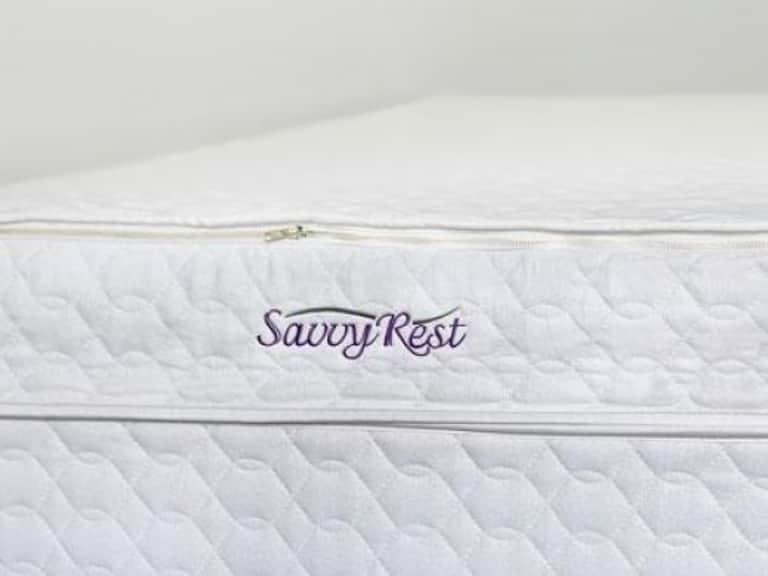
If the cover is removable, do not unzip it without permission or without knowing the manufacturer’s instructions. Some mattress covers are not washable, and removing them may affect the product’s integrity or warranty. For example, the [Savvy Rest Tranquility Latex Mattress](/products/savvy-rest-tranquility-latex-mattress-606) is described as having a zippered organic-cotton cover that is not machine washable or dry cleanable. That detail illustrates why care instructions matter: a cover that opens is not necessarily a cover intended for laundering.
Look for the original care label and any product identification label. If labels are missing, ask why and whether the seller can verify the model, size, construction, and date through other records. Labels can help distinguish one mattress from another and may contain information needed for a warranty or future care. A seller’s description is useful, but original documentation is stronger evidence.
Check hygiene with care and common sense
Hygiene is one of the most consequential questions when considering used bedding. Inspect every accessible surface for spots, rings, residue, hair, debris, or signs of liquid exposure. Pay attention to seams, tufts, quilting, handles, and the underside. If you can inspect the mattress in person, use bright, even light and take time to look around the edges rather than relying on a quick glance.
Odor can also offer clues, although it is not a reliable test by itself. A strong musty, sour, smoke-like, perfumed, or chemical smell deserves an explanation. A scent can come from storage, packaging, cleaning products, or the materials themselves; without a clear account, it may be difficult to tell which. Do not treat a seller’s use of the word “sanitized” as a substitute for details about the procedure.
Ask whether the mattress was professionally cleaned, what method was used, and whether the treatment was suitable for the cover and latex. Ask if it was allowed to dry fully before being packed or stored. Moisture trapped in bedding can create conditions that are difficult to assess from the outside. A mattress should not be accepted on the strength of a general claim that it is “freshened up.” Seek a written description of the work and any applicable service record.
Bed bugs and other household pests are a separate concern. Examine seams, piping, folds, and any gaps around a zipper, but remember that a visual inspection cannot guarantee the absence of pests. Ask the seller about its storage, handling, and pest-control procedures, especially if the mattress has been in a customer’s home or shared warehouse. If the answers are incomplete, consider whether the remaining uncertainty is acceptable to your household.
Never apply household disinfectants, bleach, solvents, or unapproved sprays to latex or its cover in an effort to make a questionable mattress feel safer. Such treatments may damage materials, leave residues, or mask rather than resolve a problem. Follow the manufacturer’s care guidance and, when the history raises a serious hygiene concern, be prepared to walk away.
Examine the latex for damage and uneven wear
If the seller permits an inspection of the latex layers, look for tears, cuts, crumbling, sticky or brittle areas, and deep impressions that remain after pressure is removed. Check the full length and width, not only the center. A mattress may have multiple layers, so ask whether they are all present, correctly oriented, and part of the original configuration. If the layers are accessible, confirm that the stack matches the product description.
Press gently in several areas and compare how the surface responds. Latex ordinarily compresses under pressure and rebounds, but the precise feel varies with formulation, thickness, firmness, and construction. One quick press cannot establish quality or remaining useful life. Instead, look for obvious differences between corresponding areas and ask whether the mattress has been stored flat on an appropriate support. A persistent depression, unusual lump, or section that behaves differently should be documented and explained.
Be cautious about interpreting natural variation as damage. Latex can have a distinct smell when new, and color or texture can vary with material and manufacturing. On the other hand, an unfamiliar scent or uneven appearance should not be dismissed automatically as normal. Ask for the manufacturer’s description of expected characteristics and compare it with what you see.
Also inspect the base or foundation used during any prior period of use. An unsuitable or damaged support system can contribute to uneven wear, and a mattress’s performance depends partly on the surface beneath it. Ask about the bed frame, slats, platform, or adjustable base on which it rested. Check the seller’s guidance for required spacing, support, and compatibility rather than assuming that any frame will do.
Confirm materials, layers, and claims
“Latex mattress” is a broad description, not a complete materials list. Ask whether the latex is natural, synthetic, or a blend, and whether the seller can identify the process used, such as Dunlop or Talalay. Ask what other materials are present in the cover, quilting, fire barrier, and comfort layers. If organic or other certification claims are important to you, request documentation that identifies exactly which materials and components are covered.
Do not assume that a certification attached to one component applies to the entire mattress. A certified cover, for instance, does not by itself establish the sourcing or composition of the latex inside. Check the certificate’s scope, the named product or material, and whether the paperwork corresponds to the specific mattress being sold.
Construction details matter for comfort and for future care. Ask how many layers the mattress contains, their thickness and firmness, whether layers can be rearranged, and whether any pieces have been substituted. A configurable design can make repair or adjustment possible, but only if the correct components are present and the seller explains how to maintain them. The configuration of a returned mattress should be confirmed rather than inferred from a model name.
These questions are especially useful if the bed is being sold without its original tags or manual. Get the details in writing: model, size, materials, layer arrangement, included components, and any known repairs. Written specifics make it easier to compare the item with the manufacturer’s information and to resolve a disagreement later.
Read the warranty and return terms before paying
A mattress may have been eligible for a warranty when it was new but no longer qualify after a sale, transfer, or return. Warranty terms vary. Some apply only to the original purchaser; some require proof of purchase, a particular foundation, or an intact law label. A limited warranty may cover particular manufacturing defects while excluding ordinary wear, comfort preferences, stains, or damage caused by improper support. Never assume coverage transfers with the mattress.
Ask the seller and, when possible, the manufacturer whether the specific returned item remains covered. Request the answer in writing and ask what document proves eligibility. If the original receipt is missing, find out whether another purchase record can be used. Confirm the warranty’s start date, length, exclusions, and who is responsible for handling a claim.
Read the return policy as closely as the warranty. Is the bed final sale? Is there a trial period, and does it apply to a returned or open-box item? Who pays for pickup or shipping? Are there restocking fees, handling charges, or required packaging? How long do you have to report a defect? A generous verbal promise has little value if it conflicts with the written terms.
Make sure the agreement identifies the mattress as returned or previously opened and records any known defects. Ask for a receipt that names the item and price, plus copies of the condition report and relevant policy. If the seller is unwilling to document the transaction, consider that a warning sign rather than a small inconvenience.
Evaluate comfort separately from condition
A mattress can be clean and structurally sound yet still be the wrong sleep surface for you. Latex may feel buoyant and responsive, but firmness depends on the particular materials, thickness, layering, and the person using it. A returned bed could also have been customized or assembled differently from the version you expected. Whenever possible, lie on the mattress for long enough to assess your usual sleep positions rather than deciding from a brief sit at the edge.
Notice whether your shoulders and hips feel comfortable, whether your spine seems well supported in your typical position, and whether the surface feels too firm or too soft. If you share the bed, both sleepers should try it. Consider the height of the mattress, the bed frame, and any topper you plan to use. A topper can change the feel, but it cannot necessarily correct a damaged or unsuitable support layer.
Ask whether the seller offers any exchange or adjustment option for a returned mattress. Do not assume that policies available for new items also apply to open-box goods. If your comfort decision depends on changing layers or adding components, verify the cost, availability, and return conditions for those pieces before buying.
A practical inspection checklist
Before committing, use a written checklist to keep the conversation focused. Photographs can help record visible condition, but they cannot replace a full inspection or written disclosures. Ask permission before photographing or opening anything.
- History: Was the mattress used, for how long, and why was it returned?
- Storage: Where was it kept, and was it protected from moisture, smoke, and pests?
- Cover: Are there stains, tears, odors, broken seams, or missing labels?
- Latex: Are there cuts, crumbling, unusual stickiness, persistent impressions, or mismatched layers?
- Materials: Are latex type, layer details, cover materials, and certifications documented?
- Cleaning: What sanitation or cleaning steps were performed, by whom, and when?
- Paperwork: Are the original manual, receipt, labels, and condition report available?
- Protection: Does the warranty still apply, and is that confirmed in writing?
- Terms: Can you return the bed, and what fees, deadlines, or transport rules apply?
- Delivery: Who handles transport, setup, and removal if the mattress proves unsuitable?
Know when to pause or walk away
Some unanswered questions are ordinary; others change the risk of the purchase. A seller who cannot document the exact model may still be able to verify it through manufacturer records. A seller who refuses to discuss prior use, hygiene, or return terms leaves you with a much larger uncertainty. Stop if you find unexplained stains, dampness, persistent odors, visible pest evidence, significant tears, or damaged latex that has no clear repair record.
Price should reflect both condition and the protections you are giving up. A discount does not make a mattress a good value if you cannot verify its history, cannot return it, and have no warranty recourse. Compare the total cost—including delivery, inspection, accessories, and possible disposal—with the cost of an alternative that comes with clearer documentation.
Take time to review the details away from the sales floor. Ask for copies of the paperwork and read them before signing. If the offer is presented as urgent, remember that a mattress is a long-term household purchase. Walking away from a poorly documented deal is a practical form of consumer protection.
If you decide to bring it home
Arrange transport that keeps the mattress clean, dry, and supported. Do not fold, bend, or compress it unless the manufacturer specifically allows that handling for the model. Protect it with suitable clean wrapping during transit, and avoid placing heavy objects on top. Before the delivery team leaves, inspect the mattress again and note any condition that differs from the written report.
Once in place, use a mattress protector compatible with the manufacturer’s care instructions. A protector can help reduce everyday exposure to spills and dust, but it does not correct an existing hygiene concern or turn an undocumented mattress into a new one. Keep the receipt, condition photographs, policy, product labels, and any correspondence together in a safe place.
Follow the maker’s instructions for the cover, ventilation, support, and rotation. Some latex designs are not intended to be flipped; others may have removable or rearrangeable layers. Check before changing the setup. If an odor, stain, or structural concern appears after delivery, contact the seller promptly and keep the mattress in its original condition while you clarify the next steps.
The decision rests on evidence
A returned latex bed is not automatically a poor choice, nor is it equivalent to a new mattress simply because it looks clean. The meaningful distinction lies in what can be verified: its history, the condition of the cover and latex, the materials inside, the cleaning and storage record, and the protections that remain available to you.
Ask direct questions, inspect carefully, and insist on clear written terms. If the seller can provide a credible account and the mattress meets your comfort and hygiene requirements, you can make a decision with fewer unknowns. If important details remain hidden, treat uncertainty as part of the cost—and consider choosing a more transparent option.